Friday, August 28, 2009

A Life Well-Sung

When I lived in New York I was a member of the Riverside Church. Among the people I met in that congregation was my friend Lisa Maldonado. She and I volunteered for the same committee, and grew to be friends as we discussed our lives in different parts of the musical world of New York.

Lisa managed an office and recording studio that belonged to one of the most prominent Broadway composers, Mitch Leigh. Thanks to my friendship with Lisa, I had the privilege of meeting Mitch on several occasions. He has enjoyed a long and lucrative career, but will always be best-known for his great show, "Man of La Mancha", wherein the lead character, Don Quixote, sings the most-recorded and most-repeated song in the history of musical theatre, "The Impossible Dream."

I was reminiscing about meeting Mitch Leigh as I watched tonight's celebration of the life of Senator Ted Kennedy. In its most recent revival, the great actor-singer Brian Stokes Mitchell portrayed Don Quixote and sang the great song to universal acclaim. Tonight he rendered it as a tribute to the senator.

I was struck as speaker after speaker, from family member to senate colleague to friend, mentioned Ted Kennedy's love of singing. Senator Hatch, his great friend and frequent adversary, talked about how he had written a song to commemorate the wedding of the senator to his wife Vicky. His long-time aide sang one of the songs they shared in frequent sing-alongs with family and staff. Apparently, Senator Kennedy made singing a part of his everyday life.

I find this remarkable because of the remarkable nature of Kennedy's life. For, in addition to an historic career in government, Ted Kennedy faced a life of almost Shakespearean tragedy, enough grief to have stifled the song of anyone.

If one is to believe both the Republican and Democratic speakers at tonight's celebration, Ted Kennedy faced the great challenges of life as patriarch of the nation's tragic celebrity family with a song. When invited to the home of the governor, he showed up with the conductor of the Boston Pops and a pianist so they could all sing after dinner. When presiding over the awarding of the Profiles in Courage Award to his rival John McCain, he arranged cakes and parties and led the singing of "Happy Birthday" to senator McCain's eleven year old son. The stories tonight all mentioned singing.

I am comforted that the more I learn about a life that was both tragic and noble, and always larger-than-life, I find that untrained, boisterous, unembarrassed singing helped to make that life possible. Singing seemed to help make the rough places plain, and the crooked straight. I am grateful to see these legislative rivals honor one another, and to hear that for every mention of political rhetoric, there were three or four mentions of singing together.

A lesson to us all.

And the world will be better for this,
That one man, scorned and covered with scars,
Still strove with his last ounce of courage
To reach the unreachable stars.

Saturday, July 25, 2009

The first sound you hear...

Do you remember the first music you heard? A lot has been made of the so-called "Mozart Effect", the popularization of intense research into the effect of music on the brain. Every now and then a new or expectant parent will ask my advice on playing music as part of the environment of the baby. They want to give their child a head-start, and are trying to be the best parents they can be.

I always tell them the same thing. It is based on my own early childhood music experiences, and my experiences as a young parent. I tell them to sing with their child. I tell them to teach their children lots of songs, and sing them together. They frequently give a dismayed disclaimer about their own singing voice. I tell them to improvise, and that the sound of their voice is the most important sound in their child's life, and that their child is not a music critic. And I tell them about my father's whistling.

I grew up 50 years ago, and my parents had been children of the Great Depression, raised in the share-cropping world of the rural south. In a path that can only be viewed as providential, they were both the first in their families to attend college, and they both studied education. I was raised with a mixture of rural family wisdom and the educational thinking of a world full of scientific conquest, baby boomer upward mobility, and the ubiquitous advice of Dr. Spock. For all the progress that was part of that time in America, it would be 30 years before the research that led to the term "Mozart Effect" would be widely disseminated. But there is no doubt that I remember the first music I heard, and that it had a life-long impact on me.

My father was known in our community as a professor and college administrator. He was also known for his community and church involvement. But to those who knew him well, he was especially known as a world-class whistler. If you woke up in our house, your first waking awareness was likely the sound of a hymn from my father's youth being whistled. If you drove by while we were in the yard, you would realize how far the sound of a well-executed whistle traveled. There were hymns, Christmas Carols and the occasional popular song. I particularly remember "Softly and Tenderly Jesus Is Calling."

When she was young my mother had an illness that resulted in pain in her vocal chords, so she was unable to sing very much. My father's whistling became the sound track of their parental nurturing. My childhood memories include all the usual things: laughter, vacations, meals, play, school. And they all come with accompaniment, pure and melodic, signifying the close presence and care of my parents.

My point in relating this version of childhood is not to point to my family as some sort of prototype of nurture. I'm sure your memories include similar characteristics. Rather, I want to express that the music that accompanies parental nurture is more important for its interweaving in the most basic of childhood experiences than for its guarantee of encouraging childhood ingenuity. In short, forget trying to give your child an intellectual head start until you have met your child's more immediate and important need, the need for your loving presence. There is plenty of time for children to grow intellectually, but precious little time for sitting on laps and riding in cars singing together, or falling asleep to the reassuring sound of a familiar whistle. Gentle singing says more than gentle speaking, and the effect of music on the brain pales in comparison to the affect of musical nurture on the whole child.

A couple of years ago my father had to have two heart valves replaced. He went through a very difficult recovery after it was discovered that the first attempt at replacing the valves had failed, and several more hospitalizations and another open-heart surgery were eventually required before he could begin getting back to normal. My brothers and I tried to stay with my mother and help as much as possible, and one morning after Dad had returned home we turned to one another with a relieved recognition. After months of listening for his labored breathing, we heard a more familiar sound coming from his bedroom, and we knew with decades of assurance that he would be alright. The sound we heard was a clear and melodic whistle, a familiar rendition of "Softly and Tenderly Jesus Is Calling."

No carefully chosen Mozart excerpt could have meant to us what that gospel hymn meant. It meant the same thing it had always meant, "Dad is close by, family is home, and everything is going to be fine."

Thursday, July 9, 2009

and a little child shall lead them

It is 6:00 AM, so I've been awake several hours. I'm adjusting to being back in Alabama after bathing in the music of Vienna for the last couple of weeks. I have been Assistant Artistic Director for the International Haydn Festival 2009, where we presented twelve concerts over five days in four different venues, including the Musikverein and the Konzerthaus. A roster of great musicians participated, including Rodney Wynkoop and his choral forces from Duke University, Greg Hobbs and singers from Highland Park Presbyterian Church in Dallas, and instrumentalists from the Los Angeles Philharmonic. The repertoire of the festival included masses and instrumental music by Franz Josef Haydn, who died 200 years ago. But it also included three international premieres, a variety of other music, and the Mozart "Requiem", which was performed at Haydn's memorial service in June of 1809.
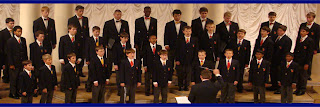
With so many great musicians performing such great repertoire, it might surprise you to know that my greatest musical memory comes from a group of boys and young men from Atlanta. The storied Atlanta Boy Choir performed in the festival, adding another successful international tour to their long history of outstanding musicianship.

On July 2, in Vienna's famed Musikverein, conductor David White led the Atlanta singers in a program that received ovation after ovation from the savvy Vienna audience, filling the silences between the songs and trying to give some small reward to the young but consummate musicians.

Did I mention that this was happening in Vienna? The ground zero of Boy Choirs? One might think that this audience would greet another Boy Choir with skepticism. But it only took four descending tones, the same tones used by Tchaikovsky to give the world his great piano concerto; the same tones Van Cliburn then played in Moscow to give musical warmth to the cold war. Those tones: sol, mi, re, do; now sung by a small boy on stage left, beginning Ralph Vaughan Williams' setting of the scriptural invitation to the Lord's table, "O taste and see...". Now it was an invitation to join these young singers for a few minutes while they celebrated all that is possible when fine art meets fine artists. "O taste and see how gracious the Lord is."

David White is a good friend, and he comes from a family of great musicians. We usually see one another at choral conventions, and once our conversation reaches the end of our family updates, we tend to resume a discussion of the generally low expectations of musical understanding and performance that people express toward children. I believe, and David's choir offers proof, that young singers are extraordinarily capable. In the 1000-year history of choral music, it is a phenomenon of the last 200 years that women would take the places of boys in the soprano and alto sections. Our greatest choral music was written for just these kinds of voices.

I often see and hear examples of the kind of well-meaning music education that espouses ideas like, "We must be careful with young singers, preserving their fragile voices and self-images by keeping things light and fun." I appreciate anyone whose motivation is the best interests of children. But I stood at the backstage door as these young men from Atlanta left the stage. Having worked very hard for a year, only to receive these great ovations from the world's most informed audience, their self-images couldn't have been better. And David's careful and expert approach to vocal technique left their voices anything but fragile. They turned around and sang as part of a large festival chorus in Haydn's "Heilgmesse," and were still giving their all 45 minutes later.

While the International Haydn Festival was going on, our few English-language television channels were all glued to coverage of the death of Michael Jackson. People my age remember when he burst onto the scene as a tiny boy, and continued to captivate people through most of his 50 years with unique musical performances. Now that his memorials are subsiding, I want to celebrate the consummate musicianship of another group of young boys, and the hard work that brought them to a point of international triumph. They are unlikely to grow up to the kind of fame that ensures wild eccentricities, and that is fueled by record sales. They will become teachers and lawyers and fathers and scoutmasters. But they deserve to be celebrated as artists while they are still in their boyhood, for they succeeded in the attainment of the artist's fondest goal. They prepared and performed the greatest art, and their audience heard and understood.

My favorite moment of their performance came in the presentation of Viennese composer Anton Bruckner's piece "Os Justi." Here are it's words in English translation (with a pertinent edit), a fitting benediction:

The mouth of the righteous utters wisdom,
and his tongue speaks (sings?) what is just.
The law of his God is in his heart;
and his feet do not falter. Alleluia.


Friday, June 19, 2009

Christopher's ipod


My favorite week of the year comes in June, when my son Christopher and I continue our trek to attend a baseball game in every major league stadium. This year we saw games in St. Louis, Milwaukee and both Chicago stadiums (stadia for purists). We have now visited twenty of the thirty ballparks. Of course, baseball is not the point, although it's enjoyable. The great pleasure comes from spending a week with my son.

Chris is always entertainment director for the trip, and I get to listen to the music he keeps on his ipod. Like most of today's teenagers, he has eclectic taste. If he sets the ipod to play titles randomly, I hear music from many genres. I seem to remember our generation being more stylistically confined. Didn't we categorize ourselves at that age, confining our listening to either pop or metal or country radio stations? Today's kids don't live with a lot of self-erected barriers, and that seems like a good thing to me. I can't help remembering a man in a congregation I served years ago who told me, "I like both kinds of music, Country AND Western."

As I enjoyed listening to this eclectic sampling of music and singing along with my son, I couldn't help wondering about the benefit of seeing Christopher's ipod, where so many songs co-exist, as a metaphor for a better church. Everywhere I look, churches and their appointed music leaders are fighting over music. The arguments about musical style have taken on a significance wildly out of proportion to the larger goals of the church. In our city, a member of a church's personnel committee can drive past homeless or inadequately housed people, drug addicted people, poverty-stricken children, poorly fed families, seldom-visited senior adults, and sick uninsured people on their way to a meeting where they will discuss terminating their church's music director because they don't like the music chosen for worship. This seems terribly perverse.

I had a conversation this week with a friend who is a church musician and an academic leader in a school that trains future church musicians. He was excited about reporting on a conference he had attended where there was a joyous welcoming spirit displayed by participants who came from different sides of the worship divide. He felt so energized by the fact that contemporary church musicians enjoyed being with traditional ones, and traditional ones enjoyed being with their contemporary worship colleagues. It was exciting to discuss the possibilities for the church if our musicians and congregations all displayed this openness to one another.

I am among those church musicians who live in a very liturgical, classical world. But no matter how I may try to serve the church diligently by presenting my best musical leadership, my value to the church's mission is diminished when I try to criticize or minimize the efforts of others whose worlds are characterized by "contemporary" or "praise and worship" styles of worship. No rendition of classical music is more valuable to the church than a pure and contrite heart. Every time people competed for Christ's approval in the Bible he dismissed the competition. Today's church musicians work very hard and live under a lot of pressure, and that situation can cause them to become like the brothers who argue about who will be seated on Jesus' right in the kingdom.

I suggest that all of us who direct music in the church, no matter what style of music feels like home to us, seek to lead the way to unity within the church. First, let us view our music leadership as an exercise in stewardship rather than performance. Let us strive to be the best stewards of our musical resources, and to lead our church's musicians and congregation to do their best. Then I suggest that we don't just try to use our musical tools to accomplish this within our own churches, but rather that we reach outside our comfort and employment zones. Let's call our colleagues at differently-worshiping churches and combine our efforts to build a "Habitat" house, or volunteer at a shelter, or tutor at-risk kids. Let's show that we can serve without receiving applause or validation. Let's show that the church is more to us than a performance opportunity. Let's exist alongside each other like the different songs on Christopher's ipod, never thinking that part of our purpose is to supplant the other songs.

Thursday, June 4, 2009

Elijah

A month ago we presented a performance of Mendelssohn's great oratorio "Elijah". At our church we present a major work each spring, and for the last two years we have invited other choirs to collaborate with us for this concert. These collaborations make our performances better, and we believe they make a contribution to our community.

This year the singers and directors of Vestavia Hills United Methodist Church, the Episcopal Church of the Ascension, Vestavia Hills High School, St. Alban's Episcopal Church, South Highland Presbyterian Church, the Birmingham Concert Chorale and the Birmingham Chamber Chorus combined their efforts with ours to create a successful concert.

Some clips are available on Youtube, thanks to the work of Lee Watford and Xavier Roberson. Please take a look.

http://www.youtube.com/watch?v=Rcw80jfgMAM
http://www.youtube.com/watch?v=293o4f8zZr4
http://www.youtube.com/watch?v=UzudEVr6gM8
http://www.youtube.com/watch?v=L_nYGu_7Xc0

Thursday, May 28, 2009

Pentecost


I am a church musician in a church that follows the liturgical calendar. According to the tradition of the church, this Sunday is Pentecost Sunday. It marks the time forty days after the resurrection of Christ, when the Holy Spirit came and the church was established.

A lot of sermons will be preached this weekend about Pentecost, and many will focus on the attributes commonly ascribed to the Holy Spirit. When I was growing up in the 1970s, a lot of churches were struggling as they determined how to react to a rise in "Pentecostalism". People were exhibiting the more spectacular of the "gifts" of the Holy Spirit. They were speaking in unknown tongues, prophecying, seeing visions, and all sorts of "gifts" that made the people who were sitting near them in church pretty uncomfortable.

As music educators and church musicians, we deal with the idea of "giftedness" on a daily basis. We advocate musical training and understanding for everyone, but we also recognize that some people possess musical gifts, or talents, that make them "VIPs" within our musical organizations. Many within the church believe that those talents, or gifts, have come from the Holy Spirit, and should be used to glorify God.

I think Pentecost gives us a good reminder that our time might be well-spent if, instead of looking for spectacular and controversial exhibitions of the arrival and presence of the Holy Spirit, we sought to identify the musical giftedness of the people in our congregations. Once identified, they give us the opportunity to practice good stewardship of those gifts as we lead and teach the gifted. Our Pentecost celebration takes place on one Sunday each calendar, but our stewardship of the gifts the Holy Spirit gives must be our task throughout the year.

As church musicians our real task is stewardship. We are mistaken if we think that our job is determining the musical taste of the congregation, although if you listen to our conversations with one another, you might think that musical taste is our primary concern. God has been worshiped for many millennia before modern musical understandings, and will continue to be worshiped when our current ideas have faded.

Our task is more rewarding and healthy for us and for the church if we strive to identify the musical gifts of the congregation, and create an environment in which the church learns to be excellent stewards of those gifts. And it is likely that a side-effect of that effort will be a steady rise in the appreciation of musical compositions we consider to be of high quality and profound meaning. Promoting good stewardship of our church's gifts is God-centered. Promoting our own musical taste is self-centered.

Tuesday, May 12, 2009

The Music Musicians Hear

This week the Alabama Symphony Orchestra will perform Beethoven's Ninth Symphony. I sing in the Birmingham Concert Chorale, the chorus who performs with the ASO when they schedule choral/orchestral pieces. This popular work, which everyone knows from the tune "Ode to Joy", has been made more legendary by the well-known fact that Beethoven was deaf when he composed it and conducted its premiere.

In his book "Beethoven's Hair," Russell Martin explains how scientific testing has been done on a lock of hair cut from Beethoven's head and verifiably preserved . The testing solved the mystery of Beethoven's deafness and growing blindness, as well as his abdominal discomfort and generally sour disposition. He had lead poisoning.

Non-musicians find it odd that a composer could compose without hearing. Musicians understand, I think, that music plays in our minds whether or not it is audible.

A few days ago I conducted Mendelssohn's "Elijah." It is a two-hour (plus) masterpiece, full of beautiful singing and orchestral playing. Every year I conduct a major work in the spring as a part of the effort to raise scholarship funds in memory of our organist, Betty Sue Shepherd. Mentally and physically it is the most challenging weekend of the year, and it has taken a few days to process mentally and recover physically.

One of the interesting things that has been said by choir members as we have reflected on the concert has been, "I try to go to sleep and that melody keeps playing in my head." I have experienced the same thing, after learning such a large score. Sometimes I have to start at the beginning and play the entire piece in my mind before I can really settle down and go to sleep.

Music is such a mental exercise that I think the real musical instrument that we all play is our mind. It is assisted by the trumpets, violins, vocal chords and pianos we manipulate. It is reassuring to know that music can't really ever be taken from us as long as our minds are strong. And I have visited elderly patients whose minds were past the point of normal communication or expression, but who showed signs of memory and recognition when familiar hymns were played or sung.

Music is too great to be momentary. We must savor great music, and play it over and over to realize its potential for enriching us. As we sing Beethoven's Ninth this week, we will reach a point where we tire of rehearsing it. But we won't be able to stop it from playing over and over in our minds after rehearsal. In that way we will finally commune with Beethoven, and experience the music the way he did.