Friday, October 16, 2009

Good and Bad Miracles


A character on a television show was recently describing Mozart. He was telling that Wolfgang's father thought him to be a miracle, and felt a duty to take him all over Europe and let the miracle be seen. I'm pretty convinced that the father's perceived miracle lay in the profits he earned by exploiting his son's talent. At any rate, the end of the story, of course, is that Mozart became a childish adult. His adulthood started at the age of five or six, and he never matured normally. The world got to witness a miraculous talent, and the miraculously talented performer paid a very high price.
The recent death of Michael Jackson brings a similarly exploitive childhood to mind, as do the biographies of Britney Spears and her sister. I'm not comparing their talents to those of Mozart, rather the fact that their parents took a step beyond normal parental pride. Their talent, which many consider to be supernatural, became a source of both pride and income, and the talented child suffered for it.

Music can have a miraculous effect on children. All musical mentors in schools, churches or private studios can recount cases of prodigious talent that became a source of nurture and discipline in a child's life. They can also tell stories of students with no musical capital to spend, but whose musical experience had a profound effect on their lives.

The miracle of musical effect on a child who doesn't display unusual talent seems to me to be the greatest miracle of all. While I enjoy working with an advanced student, and seeing the minute-by-minute growth that occurs in their ability and understanding, I find most rewarding the situations where a child who has joined the choir with no real contribution to offer finds their life improved and their perspective opened. And I am certain that the parental pride in those families is equally strong, but in no way exploitive.

I know a child with profound hearing difficulty, who chose not to attend children's choir because the noise of the room was so disconcerting when filtered through her hearing aid. Consequently, I never really got to see her fun personality. When she made the attempt to come to Youth Choir, it was because of her efforts to fit completely into the group with all her classmates. I worried that the choir experience might still not work for her. Her mother told me she was committed to trying. It was difficult to ever hear her voice, and when I did it was not surprising that pitch was difficult.

She remained true to her commitment, and as she felt more comfortable, she began to play the piano for me when she arrived early. She played by ear, but had mastered some of the popular songs she enjoyed over headphones. She obviously had a musical talent that was in direct conflict with her hearing disability. One day I was passing by her as we were singing, and I was overjoyed to hear her clearly singing the alto part in tune.

The miracle happening before my eyes could be described as the victory of her musical ability over her hearing disability. I think this is a bigger miracle than seeing a prodigious talent perform with inevitable success. I love to listen to Mozart, but the sound of a young voice singing an alto part is the bigger miracle.

Wednesday, September 23, 2009

You Are My Sunshine, My Only Sunshine

Among the privileges afforded those of us who work in houses of worship is the opportunity to be involved in the crucial times of peoples' lives. We are usually there for the turning points and pivotal moments. When children are baptized, when couples are married, when illness leads to hospitalization, and when life comes to an end we are there.

There is a lot about church work that calls to mind the old adage about seeing sausage being made. The day-to-day work of committee meetings, decision making, choir rehearsals, calendar planning, and most of all budgeting can lead one to renege on a commitment to the sausage business.

Holy moments are privileges, though. It is part of our human nature to muse about the existence of a higher power, and to imagine that we somehow possess a level of understanding about that creating and sustaining entity. But the holy moments, when we know as surely as our baby has been safely born that there is something greater than ourselves, lead us beyond the musings of human nature, to a place of faith and confidence. We don't really know very much about God's God-ness, but at those times we know that God is enough and that we are not.

Two wonderful members of our church passed away this week. Both had faced long struggles, and had inspired their family and friends with their faithful and valiant spirits. I was discussing one of these people today with a member of the choir who had gone to visit her recently. She had suffered a string of debilitating strokes, and couldn't speak clearly. Her husband remained by her side and tried to interpret, and it was evident that her thoughts were clear even though she couldn't express them through speech.

The visitor had instinctively started to sing. Holding the hand of the suffering woman, she sang,

You are my sunshine, my only sunshine.

The woman's eyes lit a little brighter and her mouth began to move.

You make me happy when skies are gray.

She began to phonate. The pitches were clear and the words were coming.

You'll never know, dear, how much I love you.

Communicating for the first time in a long time, with the old familiar feeling that what she was thinking was actually coming out clearly through her mouth.

Please don't take my sunshine away.

This simple childhood song gave a dying patient one last opportunity to express herself with clarity and meaning, a skill that had otherwise been lost. She requested through her gestures and her eyes that they sing it over and over. She didn't want to lose the moment.

Singing goes with a holy moment. Those of us who are privileged to share in these moments would do well to remember that just as God's God-ness is inexpressible, music's power to express is unexplainable. This true story is a fitting metaphor for the power of music to enable us to express what we most need to communicate. And when we can't communicate at all, it is a great gift to spend one more verse expressing ourselves clearly.

Friday, September 11, 2009

Singing about attack


September 11 marks a gut-wrenching memory of loss, attack and devastation. My memories are vivid, as I was in Manhattan, having moved there just five weeks before. A former student had helped me to find an efficiency apartment in Jersey City, so I commuted every morning and afternoon on the PATH train, the trans-Hudson subway taken by millions of people who live in New Jersey. The train had two routes, Penn Station and World Trade. I had taken the World Trade train just that weekend to have dinner at a friend's house, but on weekdays I took the train to Penn Station. I emerged every morning from beneath Macy's department store and walked around the corner to my office on 36th Street.

When I came out of the subway tunnel on September 11 my cell phone was ringing, which was unusual at that time of day. It was my wife in Alabama, asking if I was all right. I learned quickly that everyone was watching on television as they reported the unthinkable, two private airplanes had crashed into the World Trade Center. Only later did they realize they were commercial jets.

I ran to the office and everyone was gathered around radios, trying to decide whether to evacuate, since we were in the shadow of the Empire State Building. I decided to go down to an ATM on 5th Avenue and take some cash out, in case I had to stay in Manhattan. As I neared the corner I witnessed a surreal sight on 5th Avenue. There was no traffic, but it was filled with pedestrians moving north, away from the World Trade Center. They were walking north but looking south over their shoulders in disbelief. As I followed their eyes and looked south, we all saw the second tower collapse. When the dust cleared and the cameras filmed the cavity where the buildings had stood, the one remaining recognizable thing was the PATH train, buried under layers of debris.

I made it home by improvising a ride across the river on a party boat, then walking toward a tall building I recognized near my apartment. I was stuck there for several days, talking to home frequently and assuring them that I was OK.

By the next weekend the trains were running, so I set out to find a church service to attend on Sunday morning. I went to St. Thomas Church, home of the legendary choir of men and boys, expecting to be uplifted by liturgy and beautiful music. And I certainly was deeply affected by the sermon, the readings, the prayers, and the music.

But the most uplifting thing that happened occurred during the receiving of the offering. As the plates were presented we rose to sing, and I expected to join in the familiar "Doxology." Instead, the organ introduced the familiar song "America the Beautiful." A packed church, full of titans of business and finance, rose in unison and leaned their heads back defiantly to sing, "thine alabaster cities gleam, un-dimmed by human tears."

In a city known for emotional detachment and a hard exterior, the familiar patriotic song cracked the surface and gave the congregation the opportunity to vent their strongest feelings. Every voice sang, and every eye cried. The song we usually sing in a perfunctory way had become our defiant lament, and we were ennobled and uplifted while we sang it.

Friday, August 28, 2009

A Life Well-Sung

When I lived in New York I was a member of the Riverside Church. Among the people I met in that congregation was my friend Lisa Maldonado. She and I volunteered for the same committee, and grew to be friends as we discussed our lives in different parts of the musical world of New York.

Lisa managed an office and recording studio that belonged to one of the most prominent Broadway composers, Mitch Leigh. Thanks to my friendship with Lisa, I had the privilege of meeting Mitch on several occasions. He has enjoyed a long and lucrative career, but will always be best-known for his great show, "Man of La Mancha", wherein the lead character, Don Quixote, sings the most-recorded and most-repeated song in the history of musical theatre, "The Impossible Dream."

I was reminiscing about meeting Mitch Leigh as I watched tonight's celebration of the life of Senator Ted Kennedy. In its most recent revival, the great actor-singer Brian Stokes Mitchell portrayed Don Quixote and sang the great song to universal acclaim. Tonight he rendered it as a tribute to the senator.

I was struck as speaker after speaker, from family member to senate colleague to friend, mentioned Ted Kennedy's love of singing. Senator Hatch, his great friend and frequent adversary, talked about how he had written a song to commemorate the wedding of the senator to his wife Vicky. His long-time aide sang one of the songs they shared in frequent sing-alongs with family and staff. Apparently, Senator Kennedy made singing a part of his everyday life.

I find this remarkable because of the remarkable nature of Kennedy's life. For, in addition to an historic career in government, Ted Kennedy faced a life of almost Shakespearean tragedy, enough grief to have stifled the song of anyone.

If one is to believe both the Republican and Democratic speakers at tonight's celebration, Ted Kennedy faced the great challenges of life as patriarch of the nation's tragic celebrity family with a song. When invited to the home of the governor, he showed up with the conductor of the Boston Pops and a pianist so they could all sing after dinner. When presiding over the awarding of the Profiles in Courage Award to his rival John McCain, he arranged cakes and parties and led the singing of "Happy Birthday" to senator McCain's eleven year old son. The stories tonight all mentioned singing.

I am comforted that the more I learn about a life that was both tragic and noble, and always larger-than-life, I find that untrained, boisterous, unembarrassed singing helped to make that life possible. Singing seemed to help make the rough places plain, and the crooked straight. I am grateful to see these legislative rivals honor one another, and to hear that for every mention of political rhetoric, there were three or four mentions of singing together.

A lesson to us all.

And the world will be better for this,
That one man, scorned and covered with scars,
Still strove with his last ounce of courage
To reach the unreachable stars.

Saturday, July 25, 2009

The first sound you hear...

Do you remember the first music you heard? A lot has been made of the so-called "Mozart Effect", the popularization of intense research into the effect of music on the brain. Every now and then a new or expectant parent will ask my advice on playing music as part of the environment of the baby. They want to give their child a head-start, and are trying to be the best parents they can be.

I always tell them the same thing. It is based on my own early childhood music experiences, and my experiences as a young parent. I tell them to sing with their child. I tell them to teach their children lots of songs, and sing them together. They frequently give a dismayed disclaimer about their own singing voice. I tell them to improvise, and that the sound of their voice is the most important sound in their child's life, and that their child is not a music critic. And I tell them about my father's whistling.

I grew up 50 years ago, and my parents had been children of the Great Depression, raised in the share-cropping world of the rural south. In a path that can only be viewed as providential, they were both the first in their families to attend college, and they both studied education. I was raised with a mixture of rural family wisdom and the educational thinking of a world full of scientific conquest, baby boomer upward mobility, and the ubiquitous advice of Dr. Spock. For all the progress that was part of that time in America, it would be 30 years before the research that led to the term "Mozart Effect" would be widely disseminated. But there is no doubt that I remember the first music I heard, and that it had a life-long impact on me.

My father was known in our community as a professor and college administrator. He was also known for his community and church involvement. But to those who knew him well, he was especially known as a world-class whistler. If you woke up in our house, your first waking awareness was likely the sound of a hymn from my father's youth being whistled. If you drove by while we were in the yard, you would realize how far the sound of a well-executed whistle traveled. There were hymns, Christmas Carols and the occasional popular song. I particularly remember "Softly and Tenderly Jesus Is Calling."

When she was young my mother had an illness that resulted in pain in her vocal chords, so she was unable to sing very much. My father's whistling became the sound track of their parental nurturing. My childhood memories include all the usual things: laughter, vacations, meals, play, school. And they all come with accompaniment, pure and melodic, signifying the close presence and care of my parents.

My point in relating this version of childhood is not to point to my family as some sort of prototype of nurture. I'm sure your memories include similar characteristics. Rather, I want to express that the music that accompanies parental nurture is more important for its interweaving in the most basic of childhood experiences than for its guarantee of encouraging childhood ingenuity. In short, forget trying to give your child an intellectual head start until you have met your child's more immediate and important need, the need for your loving presence. There is plenty of time for children to grow intellectually, but precious little time for sitting on laps and riding in cars singing together, or falling asleep to the reassuring sound of a familiar whistle. Gentle singing says more than gentle speaking, and the effect of music on the brain pales in comparison to the affect of musical nurture on the whole child.

A couple of years ago my father had to have two heart valves replaced. He went through a very difficult recovery after it was discovered that the first attempt at replacing the valves had failed, and several more hospitalizations and another open-heart surgery were eventually required before he could begin getting back to normal. My brothers and I tried to stay with my mother and help as much as possible, and one morning after Dad had returned home we turned to one another with a relieved recognition. After months of listening for his labored breathing, we heard a more familiar sound coming from his bedroom, and we knew with decades of assurance that he would be alright. The sound we heard was a clear and melodic whistle, a familiar rendition of "Softly and Tenderly Jesus Is Calling."

No carefully chosen Mozart excerpt could have meant to us what that gospel hymn meant. It meant the same thing it had always meant, "Dad is close by, family is home, and everything is going to be fine."

Thursday, July 9, 2009

and a little child shall lead them

It is 6:00 AM, so I've been awake several hours. I'm adjusting to being back in Alabama after bathing in the music of Vienna for the last couple of weeks. I have been Assistant Artistic Director for the International Haydn Festival 2009, where we presented twelve concerts over five days in four different venues, including the Musikverein and the Konzerthaus. A roster of great musicians participated, including Rodney Wynkoop and his choral forces from Duke University, Greg Hobbs and singers from Highland Park Presbyterian Church in Dallas, and instrumentalists from the Los Angeles Philharmonic. The repertoire of the festival included masses and instrumental music by Franz Josef Haydn, who died 200 years ago. But it also included three international premieres, a variety of other music, and the Mozart "Requiem", which was performed at Haydn's memorial service in June of 1809.
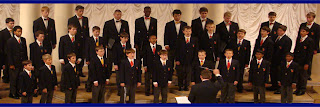
With so many great musicians performing such great repertoire, it might surprise you to know that my greatest musical memory comes from a group of boys and young men from Atlanta. The storied Atlanta Boy Choir performed in the festival, adding another successful international tour to their long history of outstanding musicianship.

On July 2, in Vienna's famed Musikverein, conductor David White led the Atlanta singers in a program that received ovation after ovation from the savvy Vienna audience, filling the silences between the songs and trying to give some small reward to the young but consummate musicians.

Did I mention that this was happening in Vienna? The ground zero of Boy Choirs? One might think that this audience would greet another Boy Choir with skepticism. But it only took four descending tones, the same tones used by Tchaikovsky to give the world his great piano concerto; the same tones Van Cliburn then played in Moscow to give musical warmth to the cold war. Those tones: sol, mi, re, do; now sung by a small boy on stage left, beginning Ralph Vaughan Williams' setting of the scriptural invitation to the Lord's table, "O taste and see...". Now it was an invitation to join these young singers for a few minutes while they celebrated all that is possible when fine art meets fine artists. "O taste and see how gracious the Lord is."

David White is a good friend, and he comes from a family of great musicians. We usually see one another at choral conventions, and once our conversation reaches the end of our family updates, we tend to resume a discussion of the generally low expectations of musical understanding and performance that people express toward children. I believe, and David's choir offers proof, that young singers are extraordinarily capable. In the 1000-year history of choral music, it is a phenomenon of the last 200 years that women would take the places of boys in the soprano and alto sections. Our greatest choral music was written for just these kinds of voices.

I often see and hear examples of the kind of well-meaning music education that espouses ideas like, "We must be careful with young singers, preserving their fragile voices and self-images by keeping things light and fun." I appreciate anyone whose motivation is the best interests of children. But I stood at the backstage door as these young men from Atlanta left the stage. Having worked very hard for a year, only to receive these great ovations from the world's most informed audience, their self-images couldn't have been better. And David's careful and expert approach to vocal technique left their voices anything but fragile. They turned around and sang as part of a large festival chorus in Haydn's "Heilgmesse," and were still giving their all 45 minutes later.

While the International Haydn Festival was going on, our few English-language television channels were all glued to coverage of the death of Michael Jackson. People my age remember when he burst onto the scene as a tiny boy, and continued to captivate people through most of his 50 years with unique musical performances. Now that his memorials are subsiding, I want to celebrate the consummate musicianship of another group of young boys, and the hard work that brought them to a point of international triumph. They are unlikely to grow up to the kind of fame that ensures wild eccentricities, and that is fueled by record sales. They will become teachers and lawyers and fathers and scoutmasters. But they deserve to be celebrated as artists while they are still in their boyhood, for they succeeded in the attainment of the artist's fondest goal. They prepared and performed the greatest art, and their audience heard and understood.

My favorite moment of their performance came in the presentation of Viennese composer Anton Bruckner's piece "Os Justi." Here are it's words in English translation (with a pertinent edit), a fitting benediction:

The mouth of the righteous utters wisdom,
and his tongue speaks (sings?) what is just.
The law of his God is in his heart;
and his feet do not falter. Alleluia.


Friday, June 19, 2009

Christopher's ipod


My favorite week of the year comes in June, when my son Christopher and I continue our trek to attend a baseball game in every major league stadium. This year we saw games in St. Louis, Milwaukee and both Chicago stadiums (stadia for purists). We have now visited twenty of the thirty ballparks. Of course, baseball is not the point, although it's enjoyable. The great pleasure comes from spending a week with my son.

Chris is always entertainment director for the trip, and I get to listen to the music he keeps on his ipod. Like most of today's teenagers, he has eclectic taste. If he sets the ipod to play titles randomly, I hear music from many genres. I seem to remember our generation being more stylistically confined. Didn't we categorize ourselves at that age, confining our listening to either pop or metal or country radio stations? Today's kids don't live with a lot of self-erected barriers, and that seems like a good thing to me. I can't help remembering a man in a congregation I served years ago who told me, "I like both kinds of music, Country AND Western."

As I enjoyed listening to this eclectic sampling of music and singing along with my son, I couldn't help wondering about the benefit of seeing Christopher's ipod, where so many songs co-exist, as a metaphor for a better church. Everywhere I look, churches and their appointed music leaders are fighting over music. The arguments about musical style have taken on a significance wildly out of proportion to the larger goals of the church. In our city, a member of a church's personnel committee can drive past homeless or inadequately housed people, drug addicted people, poverty-stricken children, poorly fed families, seldom-visited senior adults, and sick uninsured people on their way to a meeting where they will discuss terminating their church's music director because they don't like the music chosen for worship. This seems terribly perverse.

I had a conversation this week with a friend who is a church musician and an academic leader in a school that trains future church musicians. He was excited about reporting on a conference he had attended where there was a joyous welcoming spirit displayed by participants who came from different sides of the worship divide. He felt so energized by the fact that contemporary church musicians enjoyed being with traditional ones, and traditional ones enjoyed being with their contemporary worship colleagues. It was exciting to discuss the possibilities for the church if our musicians and congregations all displayed this openness to one another.

I am among those church musicians who live in a very liturgical, classical world. But no matter how I may try to serve the church diligently by presenting my best musical leadership, my value to the church's mission is diminished when I try to criticize or minimize the efforts of others whose worlds are characterized by "contemporary" or "praise and worship" styles of worship. No rendition of classical music is more valuable to the church than a pure and contrite heart. Every time people competed for Christ's approval in the Bible he dismissed the competition. Today's church musicians work very hard and live under a lot of pressure, and that situation can cause them to become like the brothers who argue about who will be seated on Jesus' right in the kingdom.

I suggest that all of us who direct music in the church, no matter what style of music feels like home to us, seek to lead the way to unity within the church. First, let us view our music leadership as an exercise in stewardship rather than performance. Let us strive to be the best stewards of our musical resources, and to lead our church's musicians and congregation to do their best. Then I suggest that we don't just try to use our musical tools to accomplish this within our own churches, but rather that we reach outside our comfort and employment zones. Let's call our colleagues at differently-worshiping churches and combine our efforts to build a "Habitat" house, or volunteer at a shelter, or tutor at-risk kids. Let's show that we can serve without receiving applause or validation. Let's show that the church is more to us than a performance opportunity. Let's exist alongside each other like the different songs on Christopher's ipod, never thinking that part of our purpose is to supplant the other songs.